Development of Standard Work Improves People and Parts
In 1933, Toyota’s Taiichi Ohno discovered the need for Standard Work, demonstrating that Standard Work drives consistency and is the baseline for improvement. Took this concept and expanded the definition in a process flow diagram defined by a meaningful acronym. FACTUAL® (Focus, Approach, Converge, Test, Understand, Apply, Leverage) is Standard Work that takes the concept beyond factory floor processes to produce consistent engineers. Then decided to apply Standard Work even further and tackle a dyslexic individual’s biggest problem – inconsistency.
Developed a comprehensive list of weaknesses and strengths and discovered that using an ingenious compensation strategy like FACTUAL® always resulted in consistency. At a higher level, problems could be transformed into gifts (skills), then into Standard Work for use by anyone. Both dyslexic and non-dyslexic individuals could follow a process defined by Standard Work.
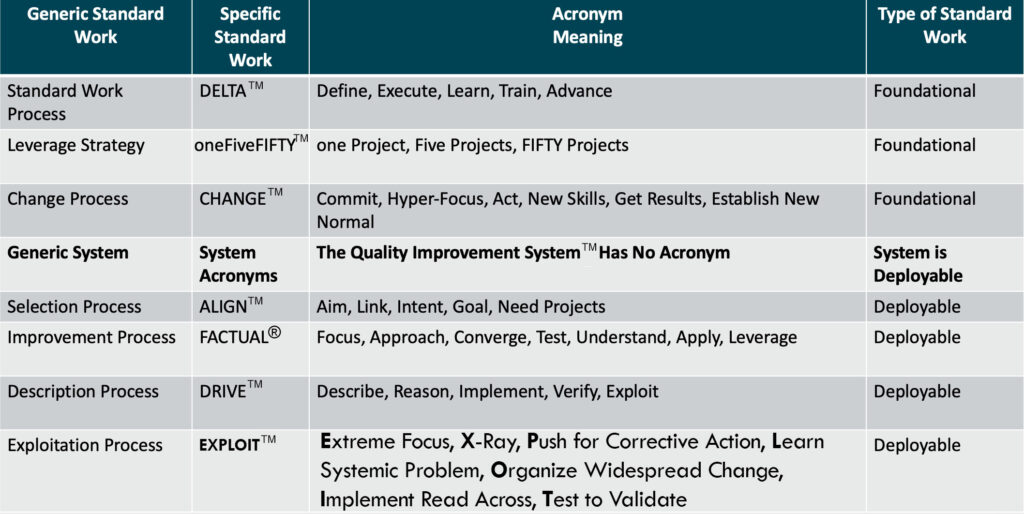
The first column of the matrix is a generic expression of Standard Work. The acronyms shown in the second column are represented by meaningful names. Each letter in the acronym represents a step in the process. The meaning of each acronym step is shown in the third column. There are two types of Standard Work expressed in the fourth column – there is Foundational Standard Work and Deployable Standard Work.
All trademarks within the table represent Improving Parts. RECOVER and GIFTED represent Improving People.